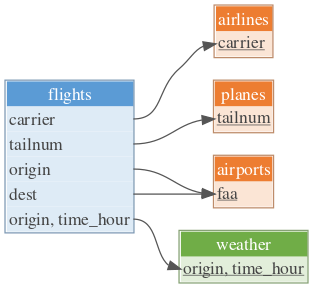
Use these methods without the '.dm_zoomed' suffix (see examples).
Usage
# S3 method for class 'dm_zoomed'
left_join(
  x,
  y,
  by = NULL,
  copy = NULL,
  suffix = NULL,
  ...,
  keep = NULL,
  na_matches = c("na", "never"),
  multiple = "all",
  unmatched = "drop",
  relationship = NULL,
  select = NULL
)

# S3 method for class 'dm_keyed_tbl'
left_join(
  x,
  y,
  by = NULL,
  copy = NULL,
  suffix = NULL,
  ...,
  keep = FALSE,
  na_matches = c("na", "never"),
  multiple = "all",
  unmatched = "drop",
  relationship = NULL
)

# S3 method for class 'dm_zoomed'
inner_join(
  x,
  y,
  by = NULL,
  copy = NULL,
  suffix = NULL,
  ...,
  keep = NULL,
  na_matches = c("na", "never"),
  multiple = "all",
  unmatched = "drop",
  relationship = NULL,
  select = NULL
)

# S3 method for class 'dm_keyed_tbl'
inner_join(
  x,
  y,
  by = NULL,
  copy = NULL,
  suffix = NULL,
  ...,
  keep = FALSE,
  na_matches = c("na", "never"),
  multiple = "all",
  unmatched = "drop",
  relationship = NULL
)

# S3 method for class 'dm_zoomed'
full_join(
  x,
  y,
  by = NULL,
  copy = NULL,
  suffix = NULL,
  ...,
  keep = NULL,
  na_matches = c("na", "never"),
  multiple = "all",
  relationship = NULL,
  select = NULL
)

# S3 method for class 'dm_keyed_tbl'
full_join(
  x,
  y,
  by = NULL,
  copy = NULL,
  suffix = NULL,
  ...,
  keep = FALSE,
  na_matches = c("na", "never"),
  multiple = "all",
  relationship = NULL
)

# S3 method for class 'dm_zoomed'
right_join(
  x,
  y,
  by = NULL,
  copy = NULL,
  suffix = NULL,
  ...,
  keep = NULL,
  na_matches = c("na", "never"),
  multiple = "all",
  unmatched = "drop",
  relationship = NULL,
  select = NULL
)

# S3 method for class 'dm_keyed_tbl'
right_join(
  x,
  y,
  by = NULL,
  copy = NULL,
  suffix = NULL,
  ...,
  keep = FALSE,
  na_matches = c("na", "never"),
  multiple = "all",
  unmatched = "drop",
  relationship = NULL
)

# S3 method for class 'dm_zoomed'
semi_join(
  x,
  y,
  by = NULL,
  copy = NULL,
  ...,
  na_matches = c("na", "never"),
  suffix = NULL,
  select = NULL
)

# S3 method for class 'dm_keyed_tbl'
semi_join(x, y, by = NULL, copy = NULL, ..., na_matches = c("na", "never"))

# S3 method for class 'dm_zoomed'
anti_join(
  x,
  y,
  by = NULL,
  copy = NULL,
  ...,
  na_matches = c("na", "never"),
  suffix = NULL,
  select = NULL
)

# S3 method for class 'dm_keyed_tbl'
anti_join(x, y, by = NULL, copy = NULL, ..., na_matches = c("na", "never"))

# S3 method for class 'dm_zoomed'
nest_join(
  x,
  y,
  by = NULL,
  copy = FALSE,
  keep = NULL,
  name = NULL,
  ...,
  na_matches = c("na", "never"),
  unmatched = "drop"
)

# S3 method for class 'dm_zoomed'
cross_join(x, y, ..., copy = NULL, suffix = c(".x", ".y"))

# S3 method for class 'dm_keyed_tbl'
cross_join(x, y, ..., copy = NULL, suffix = c(".x", ".y"))
Arguments
- x, y
tbls to join.
xis thedm_zoomedandyis another table in thedm.- by
If left
NULL(default), the join will be performed by via the foreign key relation that exists between the originally zoomed table (nowx) and the other table (y). If you provide a value (for the syntax seedplyr::join), you can also join tables that are not connected in thedm.- copy
Disabled, since all tables in a
dmare by definition on the samesrc.- suffix
Disabled, since columns are disambiguated automatically if necessary, changing the column names to
table_name.column_name.- ...
see
dplyr::join- keep
Should the join keys from both
xandybe preserved in the output?If
NULL, the default, joins on equality retain only the keys fromx, while joins on inequality retain the keys from both inputs.If
TRUE, all keys from both inputs are retained.If
FALSE, only keys fromxare retained. For right and full joins, the data in key columns corresponding to rows that only exist inyare merged into the key columns fromx. Can't be used when joining on inequality conditions.
- na_matches
Should two
NAor twoNaNvalues match?- multiple
Handling of rows in
xwith multiple matches iny. For each row ofx:"all", the default, returns every match detected iny. This is the same behavior as SQL."any"returns one match detected iny, with no guarantees on which match will be returned. It is often faster than"first"and"last"if you just need to detect if there is at least one match."first"returns the first match detected iny."last"returns the last match detected iny.
- unmatched
How should unmatched keys that would result in dropped rows be handled?
"drop"drops unmatched keys from the result."error"throws an error if unmatched keys are detected.
unmatchedis intended to protect you from accidentally dropping rows during a join. It only checks for unmatched keys in the input that could potentially drop rows.For left joins, it checks
y.For right joins, it checks
x.For inner joins, it checks both
xandy. In this case,unmatchedis also allowed to be a character vector of length 2 to specify the behavior forxandyindependently.
- relationship
Handling of the expected relationship between the keys of
xandy. If the expectations chosen from the list below are invalidated, an error is thrown.NULL, the default, doesn't expect there to be any relationship betweenxandy. However, for equality joins it will check for a many-to-many relationship (which is typically unexpected) and will warn if one occurs, encouraging you to either take a closer look at your inputs or make this relationship explicit by specifying"many-to-many".See the Many-to-many relationships section for more details.
"one-to-one"expects:Each row in
xmatches at most 1 row iny.Each row in
ymatches at most 1 row inx.
"one-to-many"expects:Each row in
ymatches at most 1 row inx.
"many-to-one"expects:Each row in
xmatches at most 1 row iny.
"many-to-many"doesn't perform any relationship checks, but is provided to allow you to be explicit about this relationship if you know it exists.
relationshipdoesn't handle cases where there are zero matches. For that, seeunmatched.- select
Select a subset of the RHS-table's columns, the syntax being
select = c(col_1, col_2, col_3)(unquoted or quoted). This argument is specific for thejoin-methods fordm_zoomed. The table'sbycolumn(s) are automatically added if missing in the selection.- name
The name of the list-column created by the join. If
NULL, the default, the name ofyis used.
Examples
flights_dm <- dm_nycflights13()
dm_zoom_to(flights_dm, flights) %>%
  left_join(airports, select = c(faa, name))
#> # Zoomed table: flights
#> # A tibble:     1,761 × 20
#>     year month   day dep_time sched_dep_time dep_delay arr_time sched_arr_time
#>    <int> <int> <int>    <int>          <int>     <dbl>    <int>          <int>
#>  1  2013     1    10        3           2359         4      426            437
#>  2  2013     1    10       16           2359        17      447            444
#>  3  2013     1    10      450            500       -10      634            648
#>  4  2013     1    10      520            525        -5      813            820
#>  5  2013     1    10      530            530         0      824            829
#>  6  2013     1    10      531            540        -9      832            850
#>  7  2013     1    10      535            540        -5     1015           1017
#>  8  2013     1    10      546            600       -14      645            709
#>  9  2013     1    10      549            600       -11      652            724
#> 10  2013     1    10      550            600       -10      649            703
#> # ℹ 1,751 more rows
#> # ℹ 12 more variables: arr_delay <dbl>, carrier <chr>, flight <int>,
#> #   tailnum <chr>, origin <chr>, dest <chr>, air_time <dbl>, distance <dbl>,
#> #   hour <dbl>, minute <dbl>, time_hour <dttm>, name <chr>

# this should illustrate that tables don't necessarily need to be connected
dm_zoom_to(flights_dm, airports) %>%
  semi_join(airlines, by = "name")
#> # Zoomed table: airports
#> # A tibble:     0 × 8
#> # ℹ 8 variables: faa <chr>, name <chr>, lat <dbl>, lon <dbl>, alt <dbl>,
#> #   tz <dbl>, dst <chr>, tzone <chr>