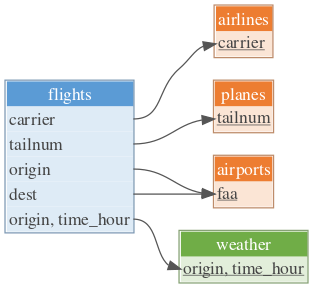
This function returns a tibble with information about
which key constraints are met (is_key = TRUE) or violated (FALSE).
The printing for this object is special, use as_tibble()
to print as a regular tibble.
Usage
dm_examine_constraints(
  .dm,
  ...,
  .progress = NA,
  .max_value = 6L,
  dm = deprecated(),
  progress = deprecated()
)
Arguments
- .dm
A
dmobject.- ...
These dots are for future extensions and must be empty.
- .progress
Whether to display a progress bar, if
NA(the default) hide in non-interactive mode, show in interactive mode. Requires the 'progress' package.- .max_value
Maximum number of distinct problematic values to report in the
problemcolumn, defaults to6. Set toInfto report all values.- dm, progress
![[Deprecated]](figures/lifecycle-deprecated.svg)
Value
A tibble with the following columns:
tablethe table in the
dm,kind"PK" or "FK",
columnsthe table columns that define the key,
ref_tablefor foreign keys, the referenced table,
is_keylogical,
problemif
is_key = FALSE, the reason for that.
Details
For the primary key constraints, it is tested if the values in the respective columns are all unique. For the foreign key constraints, the tests check if for each foreign key constraint, the values of the foreign key column form a subset of the values of the referenced column.
Examples
dm_nycflights13() %>%
  dm_examine_constraints()
#> ! Unsatisfied constraints:
#> • Table `flights`: foreign key `tailnum` into table `planes`: values of `flights$tailnum` not in `planes$tailnum`: N725MQ (6), N537MQ (5), N722MQ (5), N730MQ (5), N736MQ (5), …